




The Operating Realities of Delivering Construction in Iraq

Introduction
The case for investing in Iraq has been made.
By multilateral lenders. By advisory firms. By government road shows from London to Dubai. By the first article of this series.
What is documented far less often is what happens after the decision to invest. Not the macroeconomics. The operating realities. The difference between a well-structured deal and a delivered project.
Over more than 2 decades of continuous operation across Iraq’s public, private and energy sectors, patterns emerge that rarely appear in generic risk matrices. These are not complaints. They are conditions to plan around—and, for firms that learn to plan around them well, sources of durable advantage.
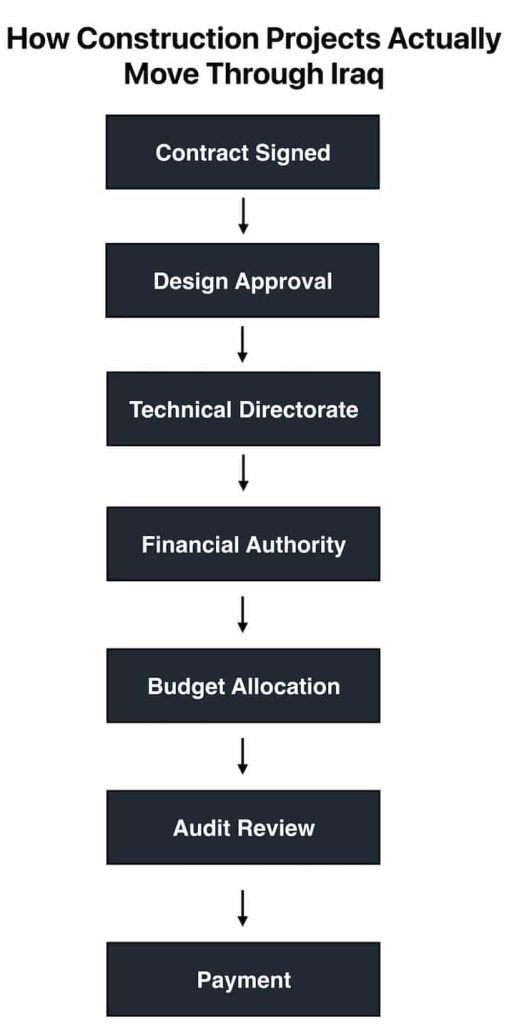
Project delivery often depends on multiple approval pathways rather than a single contractual authority.
One client but many decision-makers
Every construction contract in Iraq names a single employer. In practice, the authority to approve a design change rarely sits in one office. The authority to release a payment sits somewhere else. The authority to accept a variation sits somewhere else again.
On government-funded projects:
The signatory ministry controls the contract. But budget release depends on separate financial authorities within the ministry. Technical sign-off often sits with a different directorate than the one that issued the tender.
Audit bodies can revisit decisions well after they were made on-site. A change that seems settled in a site meeting may still travel through two or three further offices before it is genuinely final.
International oil companies operating through joint arrangements present a different structure:
Technical approval, commercial approval and government relations run through separate channels, often with more than one international partner holding a view on scope or cost. The host government retains oversight that moves on its own timeline. A contractor dealing only with the operator’s site team is dealing with one node in a wider network, not the network itself.
Private developers tend to concentrate authority more visibly, often in a single owner or family principal. But that brings its own volatility. Scope can shift with that individual’s availability in ways an institutional client would not permit.
The named counterparty is rarely the only one that matters.
Over time, experienced contractors learn to map this network early—distinguishing the signatory from the approver from the payer—and build relationships across all three.
The Signature Is Not the Approval
A site instruction given verbally in a Sunday morning meeting and never written down did not, for any commercial purpose, happen. Neither did a verbal approval. Neither did a scope change accepted with a handshake and no follow-up.
This is not a legal technicality. It is the operating rule that determines which claims survive scrutiny and which do not.
Consider what happens: verbal agreements are trusted—until there is a payment dispute. Then they are remembered differently by each party. The discipline this requires is unglamorous and continuous: site instructions confirmed in writing the same day they are given. Verbal approvals followed by a written confirmation request. Meeting minutes circulated promptly with a short window for objection.
If it isn’t recorded, it never happened. This is the reality in Iraq.
Profit Is Calculated in the Office. Survival Is Calculated at the Bank
Profit and solvency are not the same thing.
Nowhere is that distinction sharper than in Iraqi public-sector construction – that can be said confidently. A contractor can hold a healthy margin on paper and still fail—because margin does not pay next month’s payroll.
Cash does.
And cash arrives on a schedule that owes as much to the state’s budget cycle as to the contractor’s own performance.
Government payment flows are tied to an annual budget process that does not always move to a calendar-year rhythm. They are tied to oil-linked revenue the contractor has no influence over. Retention regimes release slowly, conditioned on a formal handover process that can lag well behind physical completion. Interim payment certificates require sign-off from more than one office—each additional signature a further point at which timing can slip.
None of this reflects bad faith on the client side. It reflects a payment architecture never designed around the contractor’s working-capital needs.
Over time, a different pattern emerges. The contractors who survive build their businesses around this reality rather than the payment terms printed in the contract. They negotiate supplier terms that can flex with client delay. They plan equipment financing and import duty exposure with the same rigour they apply to technical risk. Most importantly, they forecast cash on the assumption that certified payments will arrive later than scheduled—pricing and mobilising accordingly, rather than discovering the gap once it has already opened.
2026 has tested this discipline harder than most years. Disruption to Strait of Hormuz shipping cut sharply into the oil export volumes that fund the great majority of government spending, tightening state liquidity well before it reached any contractor’s account. Firms that had already built payment-timing risk into their forecasting absorbed the delay as a variance from plan. Firms that had priced against the contract’s stated terms absorbed it as a crisis.
Documentation Rarely Prevents Disputes. It Determines Who Wins Them.
This publication has argued before, in Document or Die, by Dr. Anmar Raheem, the CSO of Ibn-Yakteen; that undocumented work is one of the quiet killers of growth for Iraqi contractors.
It is worth returning to. The underlying dynamic has not changed. Its cost is still underestimated. Documentation is not paperwork laid over the real work of construction. It is the mechanism that protects quality, substantiates payment, supports claims, enables clean handover, and validates variations months or years later. It is, not incidentally, the evidence base on which a firm competes for its next tender. A project delivered to specification but poorly documented is, commercially, difficult to distinguish from one that was never delivered to specification at all.
Consider what happens: documentation is treated like bureaucracy until someone refuses to pay. Then everyone becomes a document expert overnight.
Yet Iraqi tenders are still evaluated, in practice, overwhelmingly on price. Building a proper QA/QC function, a functioning HSE system, and environmental oversight into a bid costs money before a single foundation is poured. Contractors who do this honestly will look more expensive than competitors who do not—because their price reflects a true cost others have chosen not to carry. Evaluation criteria that weigh price heavily and documentation capability lightly create a structural disadvantage for exactly the firms the market most needs.
The cost surfaces later, usually at the point of a dispute. A contractor without daily records, verified quantities, or a paper trail of site instructions struggles to substantiate a legitimate variation claim—and the client evaluating that claim, working from the same thin record, struggles equally to validate it.
Both sides lose. Though only one usually notices at the time. One thing experienced contractors eventually discover: the firms that benefit most from Iraq’s ongoing professionalisation will not necessarily be the ones with the deepest balance sheets. They will be the ones that have already absorbed the up-front cost of documentation discipline.
The Contractor Often Becomes the Project Manager
On a meaningful share of Iraqi projects, the client’s own systems for tracking decisions, managing change, or controlling documents are informal. The coordination burden transfers to whichever party in the relationship has the discipline to absorb it. On most projects, that is the contractor.
This is rarely stated in the contract. It is rarely priced. But it is consistently true. Not every counterpart a contractor works with in Iraq operates a mature project management system of its own. This is simply true of many local organisations and some governmental entities. Institutional capacity varies across any market this size, and building it takes time.
This is where Iraq differs most sharply. Experienced firms treat this as an argument for investing more, not less, in their own internal systems. A rigorous internal process for tracking decisions, controlling documents, managing change, recording meetings, and maintaining quality and risk registers does not only protect the contractor’s own performance. It frequently becomes the only reliable record the project has at all. Over time, the client’s own teams come to rely on it as such.
This is, in miniature, the posture that runs through everything here. A contractor does not need every counterpart to operate at full institutional maturity. It needs its own systems rigorous enough to create order regardless. Often, that order becomes the standard the rest of the project organises around.
Information is Iraq’s Unofficial Currency.
It is obvious that relationships matter in every construction market in the world. The honest observation about Iraq is that they matter unusually early, often before a formal track record exists to speak for a company instead.
Where audited performance histories and public credit ratings remain less developed than in mature economies, reputation does some of that work. It is how a developer decides which contractor to call first. It is how a subcontractor decides which main contractor is worth extending better terms to.
Reputation simply became the substitute when reliable information was scarce.
That reality is worth stating plainly rather than pretending it does not exist. What is equally true, and less often said, is that access opens the first conversation but rarely survives a second project on its own. A relationship built purely on proximity tends not to outlast the first missed deadline or the first dispute handled badly. One reinforced by consistent delivery becomes a genuine commercial asset, generating repeat work well beyond what any single contract would justify.
The market is also changing the balance between the two. As more projects carry international financing, and lenders and joint-venture partners bring their own diligence requirements, a documented track record increasingly travels alongside a company’s reputation rather than instead of it. For contractors that have invested in both, the two reinforce each other. For those that have only relied on the first, the ground is shifting beneath them.
Local Knowledge Is Operational Knowledge
International firms new to Iraq sometimes treat local partnership as a compliance requirement or a political nicety. The more accurate framing is operational.
Local knowledge is not a soft complement to technical capability. It is itself a form of technical capability. Substituting for it independently is expensive.
Knowing which supplier in which governorate can actually deliver on the lead time quoted, rather than the lead time promised, is local knowledge. So is knowing which permitting office’s stated timeline reflects reality, which sequencing dependencies between authorities are never written down anywhere formal, and how a utility coordination request is actually handled by the department responsible for it, as opposed to the department that owns the process on paper. Basra’s energy-sector rhythms, Baghdad’s administrative density, and the Kurdistan Region’s distinct regulatory environment differ enough that experience in one does not automatically transfer to the next.
Most foreign firms only discover this after their first dispute. It reflects the ordinary fact that this kind of knowledge takes years, and usually a number of expensive mistakes, to accumulate from scratch.
Partnering with an established Iraqi firm is a faster and considerably cheaper way to acquire it than learning it independently, project by project.
The firms that treat local partners as a source of operational intelligence, rather than only a licensing requirement, tend to have shorter, less eventful learning curves than those that do not.
International Standards Should Be Adapted, Not Imported
This is perhaps the most important point in the entire article, and we can not stress more about it: ISO management systems, the FIDIC suite of contract forms, PMBOK-based project controls; All sound. All, by any reasonable measure, fit for purpose.
Iraq’s construction sector has real reason to adopt them. The firms leading its professionalisation generally have. Over time, it becomes clear that the mistake some make is treating adoption as a matter of translation rather than adaptation.
FIDIC’s standard forms assume institutions functioning a particular way: an engineer’s determination honoured promptly, an insurance market that prices local risk efficiently, arbitration outcomes that are readily enforceable. PMBOK’s guidance on change control assumes a counterpart with its own mature project management office sitting across the table. Where those assumptions do not hold—and, as earlier sections on informal client processes make clear, they frequently do not—an unmodified international framework produces friction rather than the discipline it was designed to provide.
Professionalisation does not mean replicating a system built for London or Houston inside Baghdad or Basra. It means preserving the underlying principles those systems exist to serve—traceability, accountability, structured risk management—while rebuilding the specific mechanics of how decisions, approvals and disputes actually move through the Iraqi system. The destination is the same standard of rigour. The route is necessarily local.
Good Management Systems Compensate for Informal Client Processes
On a meaningful share of Iraqi projects, a client’s feedback on quality does not arrive through a formal non-conformance process. It arrives verbally: a comment during a site walk, an observation raised in passing, a correction that everyone present understood but no one wrote down.
The instinct this invites is frustration. The more useful response is the opposite. The lesson is rarely obvious at the beginning of a project: mature contractors do not wait for a client to adopt a formal system before building the discipline it is meant to provide. They build their own—logging client comments however informally received, tracking observations through to a documented corrective action, and confirming that a correction was verified rather than assuming implementation alone closed the loop.
Done well, this quietly reshapes the working relationship. The client experiences a contractor who follows up on every comment raised, however casually, and who can produce a clear record of what was flagged and how it was resolved if a question resurfaces later. The contractor gains the same protection a formal system would have provided, without waiting for the client’s own processes to formalise first.
Variation Orders: A Case Study in Iraqi Construction
In theory, a variation order is a contractual mechanism.
A change in scope. A change in price. A change in timeline. Documented. Agreed. Signed. In practice, in Iraq, variation orders often become something else. In reality, they become emotional. They become about trust. They become about who asked for what, when, and whether the request was reasonable. They become about whether the contractor is trying to exploit the client or whether the client is trying to squeeze the contractor.
Why?
Because nobody wants to admit they changed the scope. Nobody wants to admit they forgot something. Nobody wants to approve extra money. Nobody wants responsibility.
By the time a variation reaches the formal process, the relationship has often already soured. The conversation is no longer about the technical merits of the change. It is about who is being fair and who is not.
Consider what happens: experienced contractors avoid this by addressing variations early, in writing, before they become disputes. They document the request. They document the rationale. They document the cost implication. They seek agreement before the work is done, not after. This sounds obvious. In practice, it is rare—and rarer still in Iraq, where the culture of verbal agreement runs deep.
The BOQ Purchases Work. It Rarely Manages Work.
Procurement BOQ vs Execution BOQ
Procurement BOQ | Execution BOQ |
|---|---|
Prepared for tendering | Prepared for project execution |
Groups work into pricing items | Breaks work into executable packages |
Focuses on commercial comparison | Focuses on construction delivery |
Limited interface definition | Clearly defines interfaces between trades |
Minimal assumptions | Explicit assumptions and exclusions |
Supports bid evaluation | Supports project management and payment |
Commercial document | Operational document |
Many subcontract disputes arise because the Procurement BOQ is used as if it were an Execution BOQ. The two serve different purposes and should never be treated as interchangeable.
A large share of subcontract disputes in Iraq trace back to the same origin. A subcontract that simply copies a single line item out of the employer’s Bill of Quantities, without translating it into a scope a subcontractor can actually price, execute, and be held accountable against.
Over time, a different pattern emerges. There are actually two types of BOQ. The Procurement BOQ and the Execution BOQ. The procurement BOQ is designed for tendering. It lumps costs. It simplifies. It hides complexity. It is not designed to manage work. It is designed to purchase it.
The Execution BOQ is different. It breaks down work into executable packages. It defines interfaces. It states assumptions and exclusions explicitly. It sets acceptance criteria both sides can point to at handover.
A rate for “supply and install” means something different depending on whether it includes waste removal, temporary works, testing, or making good afterwards. If the subcontract does not specify which, both parties will eventually assume the answer that suits them.
Most subcontract disputes in Iraq begin months before the dispute itself. They begin when everyone believes they understand the same BOQ differently.
The same holds at package boundaries. Where earthworks stop and utilities begin. Who owns the interface between structure and finishes. What happens when one package’s delay pushes into another’s mobilisation window. These are not edge cases. They are the normal condition of any multi-package project, and exactly what a copied BOQ line leaves unanswered.
Contractors who avoid the resulting disputes do the less glamorous work before award rather than after. They write a full scope narrative for each package. They state assumptions and exclusions explicitly. They define the interfaces between adjacent packages. They set out acceptance criteria both sides can point to at handover.
This takes time a tight tender programme rarely wants to give it. It is, nonetheless, cheaper than the alternative.
Time, Not Schedules
International firms often look at Iraq and see a construction market where projects take longer than expected. They interpret this as inefficiency.
This is where Iraq differs from textbook construction. Delay often means the project is waiting. Waiting for one administrative dependency outside anybody’s control. Waiting for a permit. Waiting for a budget release. Waiting for a signature. Waiting for a decision from an authority that does not sit on the project steering committee.
International firms think delay means inefficiency. Experienced Iraqi contractors know delay often means waiting. The distinction matters. Inefficiency you can fix. Waiting you must absorb.
Consider what happens: a project may be running smoothly on site. Materials are arriving. Labour is working. Quality is good. And then nothing happens for three weeks. Not because of anything on site. Because the budget approval is sitting in a ministry waiting for a signature from an official who is travelling.
The contractors who survive build this into their planning. They sequence work to absorb waiting. They forecast cash to survive it. They build relationships across the decision-making network to shorten it where possible—knowing that shortening it is not always possible.
The Decade Ahead
Iraq is often described as a difficult construction market. That description is incomplete though.
Difficult markets eventually become easy once enough money is spent. However, this is not the case in Iraq; it becomes easier with understanding, and understanding, unlike equipment or capital, cannot be imported. It is earned. Year by year. Project by project. Mistake by mistake.
One thing is becoming clear: the firms that lead Iraq’s next decade will not necessarily be the largest, or those with the deepest political access. They will be the ones combining international standards with the judgment to adapt them, internal governance that does not depend on a counterpart’s maturity, documentation discipline treated as a competitive asset rather than a cost, and a working understanding of how the country operates beneath its formal structures. Built over years. Not acquired from a report.
That combination is harder to build than a strong balance sheet. It is considerably harder to copy. It is also, increasingly, what distinguishes the firms still standing after a difficult year from those that mistook the paper version of Iraq for the real one.
The opportunity this series opened with has not gone away. Realising it well is a different skill from identifying it. The market is still learning to reward that skill. The firms that learn it first will build an advantage that late entrants, no matter their capital, cannot easily replicate. Because in Iraq, the difference between a deal and a delivered project is not financing. It is not contracts. It is not relationships. It is the accumulated, unglamorous, unexportable knowledge of how things actually get done.
That knowledge cannot be bought. It can only be earned.